

Technology · Netlinks Group software
Crownler: the SEO and GEO software that shows which fights are worth picking.
Crownler reads your whole site, draws the real architecture of pages and internal links, and follows every search intention on Google and inside AI answers. It is the software Netlinks runs its own operation on, opened up for teams that would rather drive themselves.
We work in English, Portuguese and Spanish. Headquarters in Belo Horizonte, Brazil.

01Overview
SEO and GEO software
Crownler is the SEO and GEO software built by Netlinks Group, launched in September 2026. It opens with the question most of the industry skips: which fights are worth picking, before you spend a month on them. The arithmetic of who wins what is almost never done before the work starts, which is why so much SEO effort goes into ground that was never winnable.
The brand promise fits in one line: see what the Crown sees. In practice, Crownler runs a crawler of its own, lays the site out as ground, shows which page leads each topic, which pages nothing links to, and where the internal links actually go. On top of that map sit the modules for planning, content, technical audit, backlinks, reporting and monitoring.
Crownler is the software; Netlinks is the service. Clients who hire the agency get the work done for them and follow it in the Netlinks App. Teams that would rather run it themselves, in house or inside their own agency, subscribe to Crownler and work in the tool. Accounts and plans live at crownler.com.
- 15
- modules in the app, switched on one by one
- 6
- surfaces on a single intention's map
- 42
- rules in the technical audit
- 4
- languages, in the app and on the site
02Definition
What Crownler is
Crownler is an SEO and AI-visibility tool. It crawls the entire site with a crawler of its own, draws the map of pages and internal links, and follows the contest for every search intention, both on the Google results page and inside the answers generated by assistants.
The map is the starting point. Most tools on the market hand over a list of keywords and a list of errors, and leave the interpretation to whoever reads it. Crownler works the other way around: it draws the ground first, then hangs the data on it. Every page shows up where it actually sits inside the site, grouped by the topic it holds, with the page that leads that topic standing out and the pages nothing links to set apart.
Three things go wrong before anyone opens a report, and the software exists to fix all three:
- SEO gets planned in a spreadsheet that knows nothing about the site. The spreadsheet lists keywords. It does not know which page already competes for that topic, or whether a page exists for it at all.
- What decides the month surfaces late. The page with no editorial link coming in, the topic with no owner, the keyword a stronger domain already holds: all of it tends to become a discovery in next month's report.
- A growing share of the answers is written by AI. That is where almost nobody is measuring, and it is where the buyer is asking.
The crawler and the map belong to Crownler and cost nothing per page. What costs money is data bought outside (SERP, backlinks, page speed and AI with grounding), and it only moves when someone asks for it: the amount leaves the monthly allowance before the call goes out, and comes back if the call fails. It is an architectural choice that avoids the nightly sweep nobody read.
03Concept
Territory: one intention, six surfaces
Someone who wants the same thing asks Google one way and asks an assistant another. A buyer types international accounting into search and writes a full sentence when asking ChatGPT which firm to hire. Same intention, two sets of clothes.
Crownler keeps that as a single unit, the Territory, and measures it on every surface where it appears. Six sit in the model today: Google and AI Overview read from the same SERP pass, plus ChatGPT, Claude and Gemini asked over API. Perplexity is in the model and is not measured yet, which is written on the screen instead of being sold as a promise.
The surfaces disagree with each other, and that is the point. Winning in search and vanishing from the AI answer is a common picture, and the fix differs in each case. Seeing both readings together, inside the same intention, is what separates a GEO plan from a guess.
- Territory is the search intention, not the isolated keyword
- Google and AI Overview positions from the same SERP read
- ChatGPT, Claude and Gemini asked over API, with the answer stored in full
- The keyword map on Google and on AI side by side, filtered by surface

04Inside
The 15 Crownler modules
The modules are grouped the way the app groups them: the map, operations and watch. Two come with every workspace; the rest are switched on one by one, according to what the operation needs.
Site architecture
The site map and internal links, drawn by the in-house crawler. Included in every workspace.
Content cluster map
The site's pages grouped by subject on one board, with the page that leads each topic standing out. Also included.
Monthly action plan
The plan for the month that becomes the report for the month. It comes out of the map, with page and intention already assigned.
Data-driven content production
Briefs and drafts born from the map, with the intention each piece has to hold defined up front.
Backlink acquisition and management
Outreach portal by portal, with every contact, every link and every outlet on record.
Technical page specification
The blueprint of the page before anyone writes code: what it needs in content, in design and in code.
Monthly SEO report
Search Console, analytics, positions and AI visibility in one document, ready for the client.
Ad hoc SEO analysis
Focused cuts, ready to hand over when the question is specific and cannot wait for month end.
SEO project management
Tasks, deliverables and owners, so the monthly plan does not turn into a list of good intentions.
Rank and AI citation tracking
Google positions and citations in AI answers followed on the same screen, by intention.
Competitor monitoring
An alert on the day a competitor publishes, with the new page and the topic it goes after.
Editorial monitoring
Reference sources in your field read every day, so the story angle arrives before the competition's.
Crawl budget analysis
Where Google spends its crawl on your site, and what is eating budget without giving anything back.
Technical SEO audit
Rule-based audit, page by page, with 42 rules running on Crownler's own crawl.
Keyword and SERP research
Keywords, domains, backlinks and who holds the search today, with paid data fetched on the click.
05On screen
The three screens that carry the daily work
The product has fifteen modules, but the day-to-day happens in three screens. Everything the operation ships passes through them first.
- 01
The map of the site
Your whole site as ground. Pages group by topic, the page that leads each topic stands out, and the ones nobody links to sit apart. This is the screen where the plan gets drawn.
- 02
The record of one page
Where the page came from, which pages link to it from inside the site, where it sends links once menu, header and footer are out of the way, who cites it from outside, and the intentions it holds. That page's data is fetched on the click.
- 03
The report for the client
Reports, audits and analyses become a link the client opens with no account, carrying the logo and colours of whoever delivers, ready to print, with no price and no internal id on the page.
06Audience
Who Crownler was built for
The product is a workspace with projects inside it. A single site is simply a project, which lets the same software serve someone running thirty accounts and someone running one domain.
- Agencies running SEO for several clients. Each client is a project, the deliverable already carries the agency's brand, and the report becomes a link the client opens without an account. The white label carries the agency's brand.
- Consultants with a book of clients. The map replaces the audit spreadsheet built by hand, and the page specification becomes a deliverable document instead of a long email.
- In-house marketing teams. A team running its own site sees the real architecture, finds the orphan page before the report does, and hands development a specification it can execute.
- Companies that want to do it themselves. Businesses that prefer to keep the operation in house subscribe to Crownler and work in the tool, with the same reading Netlinks uses on its own projects.
Netlinks clients do not need to subscribe to anything: the agency already runs on the software and delivers the finished result inside the Netlinks App. Crownler exists for the opposite case, the team that wants its hands on the wheel.
07How it fits
Netlinks service, Crownler and the Netlinks App
The three things live side by side without overlapping. The table below shows who operates, what you receive and where you follow it in each path.
| What changes | Netlinks service | Crownler | Netlinks App |
|---|---|---|---|
| What it is | A 360 SEO and GEO agency and consultancy staffed by senior specialists | Netlinks Group's SEO and GEO software | The agency client's dashboard, included in the service |
| Who operates it | The Netlinks team, running the method every month | You and your team, inside the tool | Nobody operates it: it is where the agency's work shows up |
| What you get | Mapping, content, backlinks, press, website and reporting, done for you | Site map, plan, audit, monitoring and reports for you to produce | Approval per deliverable, live reporting and full project history |
| Who it is for | Companies that want the result without building an SEO team | Agencies, consultants and in-house teams running it themselves | Netlinks clients, with no separate purchase |
| Where it starts | Talk to an Expert | crownler.com | Opened during project onboarding |
08Integration
How Crownler talks to the Netlinks App
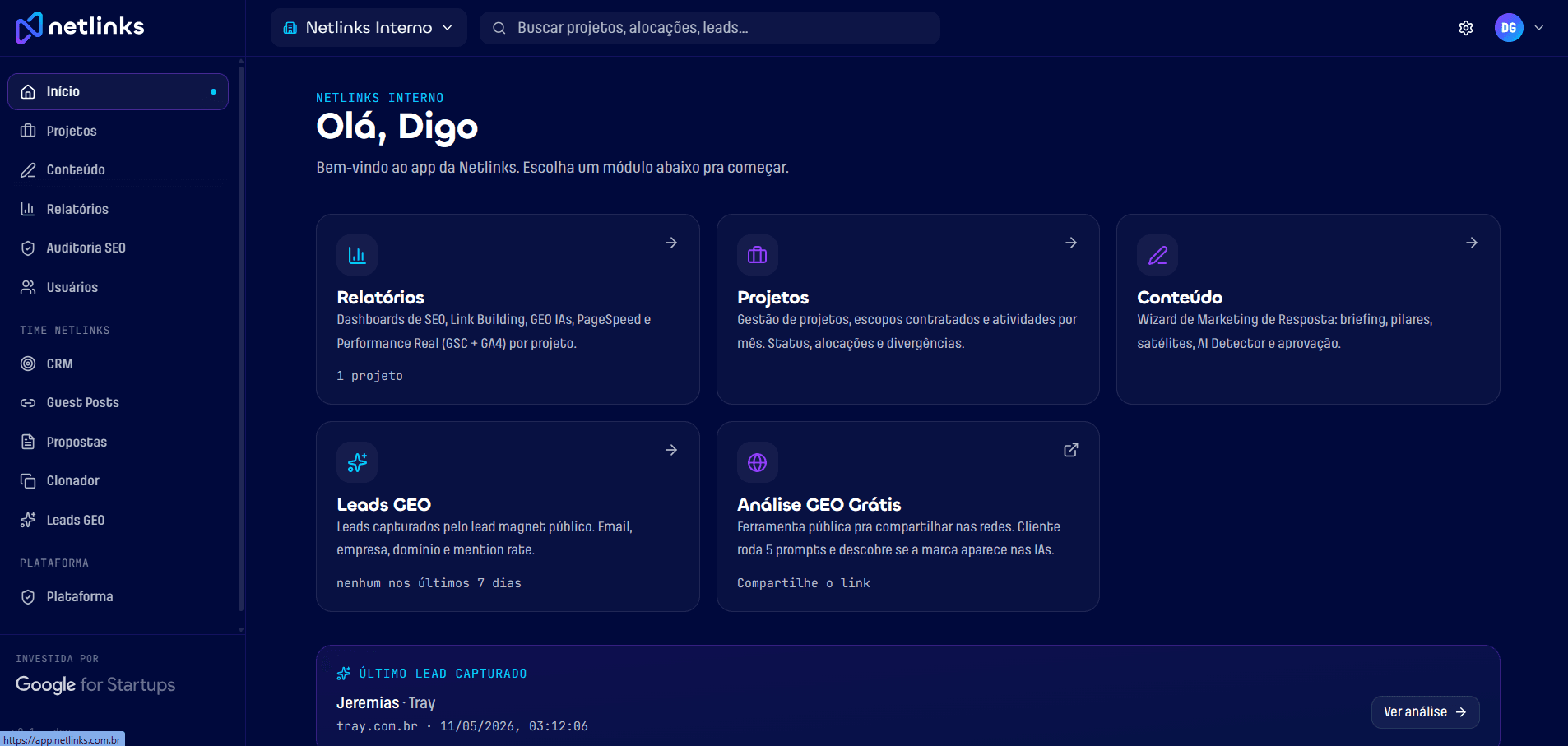
Both products belong to the same group and each covers one side of the same operation. Crownler is where the work happens: crawl, map, monthly plan, audit, page specification and monitoring. The Netlinks App is where the agency's client follows what was done: delivery queue, approvals, live reporting and history.
In practice, a Netlinks client never has to open Crownler. The monthly plan is born in the software, executed by the team, and arrives in the app as a deliverable to approve, with the published link and the updated number beside it. AI citation reading follows the same path: the measurement runs in Crownler and the result appears in the dashboard the client already uses.
For teams running it themselves, the flow reverses: Crownler hands over material already shaped for the end client, through white label reports and the API, carrying the logo and colours of whoever signs it. Our technology layer is detailed in technology, and the AI measurement front in AI monitoring.
- Monthly plan built in Crownler, delivered and approved in the Netlinks App
- AI citation monitoring measured in the software and shown in the client dashboard
- White label reporting and API v1 for teams delivering under their own brand
- Workspace data leaves through reports, delivery links and the API, with no market database built from it
09Proof
The software the agency uses every day
Crownler is the tool that carries the Netlinks operation itself, on projects in Portuguese, English and Spanish. That is why it changes every week: whatever shows up as a limitation on a real project becomes a fix the week after.
It also explains choices that only make sense to people who deliver SEO as a service. The report ships with no price and no internal id on the page because it goes to the client's client. The audit runs on the in-house crawl, inside the monthly page allowance, because an audit that costs too much stops being run. Paid data is bought on the click because a nightly sweep spends budget on pages nobody opened.
The same three people answer for both fronts: Digo Garcia (AI, technical SEO and engineering), André Mousinho (SEO strategy) and Gabriel Raposo (authority and press). Netlinks is backed by Google for Startups and works across four countries. To see how the service runs, start with the Response Marketing method and the case studies.
10Delivery
White label and API: the deliverable already belongs to the client
Agencies hand over documents carrying their own brand, and Crownler was built with that at the centre: reports, audits and analyses become a link the end client opens without creating an account, with your logo and your colours, ready to print.
API v1 opens the same data to anyone who wants the result inside another system: a client portal, an internal dashboard, a board spreadsheet. The workspace stays yours, projects and history live in it, and the data leaves through reports, delivery links or the API.
It is the same logic Netlinks applies on the service side: the client sees the result, not the machinery. Plans, allowances and what each module costs live at crownler.com, off this site.
11The deliverable
What you receive
Finished work, approved by you in the App and shipped. Not a report that only describes the problem.
A site map from an in-house crawl
The real architecture of pages, topics and internal links, drawn by Crownler's own crawler.
Territory measured on six surfaces
The same intention followed on Google, on AI Overview and in ChatGPT, Claude and Gemini answers.
Rule-based technical audit
42 rules running page by page, inside the plan's monthly allowance, with the history of every fix.
A page blueprint before the code
The specification in three readings (content, design and code) that development can actually execute.
A monthly plan that becomes the report
The plan comes out of the map, turns into tasks with owners and closes in the same month's report.
White label reporting and API
A link carrying your brand, with no account and no internal id, plus API v1 to move the data onward.
12How it works
From the audit to the page going live
The same path on every project, with an owner and a date on each step.
- 01
Create the account
The account opens at crownler.com. The workspace starts in trial, with the screen saying what is locked.
- 02
Point it at your first site
There is nothing to install and no tag to paste. The crawl starts from the sitemap when one exists, falls back to the home page when it does not, and obeys robots.txt.
- 03
Read the map
The site comes out drawn as ground: the topics that hold together, the page that leads each one, and the pages nothing links to.
- 04
Switch on the modules the operation needs
Two modules come with every workspace. The other thirteen are switched on one by one, according to the front you are about to attack.
- 05
Run the monthly plan
Briefs, content, backlinks, technical fixes and page specifications go in with an owner and a due date.
- 06
Deliver under your own brand
Reports and audits become a white label link for the end client, or leave through the API into the system you already use.
13Who it is for
Where this work pays off the most
SEO agencies
Several clients in one workspace, each as a project, with white label reporting and the agency's brand on the deliverable.
In-house marketing teams
One site, the real architecture on screen, and a specification ready to hand to development without translation.
Teams that want to run it themselves
Companies that prefer to keep the operation in house and use the same reading Netlinks uses on its own projects.
14Case studies
Results with a name, a number and a date
Real projects, with what was done and what changed. No generic charts and no promises of a position.



FAQ
Frequently asked questions
What is Crownler?
It is the SEO and GEO software built by Netlinks Group, launched in September 2026. It crawls your site, draws the map of pages and internal links, and follows the contest for every search intention on Google and in AI answers. Around that map sit the modules for content, technical audit, reporting, backlinks and project management.
What is the difference between hiring Netlinks and subscribing to Crownler?
Netlinks is an agency and consultancy: a senior team runs mapping, content, backlinks, press, website work and reporting, and you follow the finished work in the Netlinks App. Crownler is the software: subscribers operate the tool with their own team. Agency clients do not need a Crownler subscription; teams that want their hands on the wheel do.
Does Crownler replace the Netlinks App?
No. They play different roles. Crownler is where the work happens: crawl, map, plan, audit and monitoring. The Netlinks App is where the agency's client follows what was done: delivery queue, approvals, live reporting and project history, 24 hours a day.
What does Crownler call a Territory?
Territory is the search intention treated as a single unit and measured on every surface where it appears. Someone who wants the same thing asks Google one way and an assistant another, so the software keeps that intention on one map of six surfaces instead of treating each keyword as a loose spreadsheet row.
Which AI engines are measured today?
Google and AI Overview from the same SERP read, plus ChatGPT, Claude and Gemini asked over API. Perplexity is in the model and is not measured yet, and that is stated on the product screen itself.
How many modules are there and how are they switched on?
There are 15 modules, grouped into map, operations and watch. Site architecture and the content cluster map come with every workspace; the other thirteen are switched on one by one, according to the front the operation is attacking.
Can I deliver the reports under my agency's brand?
Yes. Reports, audits and analyses become a link your client opens without creating an account, carrying your logo and your colours, ready to print, with no price and no internal id on the page. Teams that prefer to move the data into another system use API v1.
Where do I find Crownler plans and pricing?
At crownler.com. This is the Netlinks site, the group's agency and consultancy, and there is no price table here. If you are deciding between hiring the service and subscribing to the software, talk to an Expert and we will help you choose, with no commitment.
Keep reading
Related services
Next step
Get a diagnosis of your case
Tell us what your company sells and to whom. One of the three looks at your scenario, points out what is holding organic back today and shows where we would start.
- A review of your site and your market, with no commitment
- An answer from a senior specialist within 24 business hours
- A direct conversation: what can be done, in what order and how deep
Prefer WhatsApp?
Chat directly with a Netlinks Expert on WhatsApp.
Rather talk now? WhatsApp is answered by the team, with Alfred covering the rest of the day.
Talk to an Expert
Fill out the form and we will get back to you within 24 business hours.