
GEO and measurement · Backed by Google for Startups
AI monitoring that shows when your brand is the answer.
Questions written the way your buyers write them, run against the models on a schedule, with every answer stored in full. You see how often your brand appears, which competitors appear instead, and what changed since the last run.
We work in English, Portuguese and Spanish. Headquarters in Belo Horizonte, Brazil.

01Overview
AI monitoring
AI monitoring measures your brand's presence inside answers generated by ChatGPT, Gemini, Claude and Perplexity, the four models the App queries through their APIs. Where classic SEO measures position in a list of links, this measures something else: whether the model names your company when someone asks for a recommendation, how often, in what context and alongside whom.
Without measurement, GEO is a conversation. With measurement it becomes work: you learn which questions you already win, which ones a competitor owns outright, and what content, authority or structured data is missing to turn each one around.
Netlinks builds the question set with you, runs the rounds against the models through their APIs, extracts brand mentions from every answer and publishes it all in the Netlinks App, 24 hours a day. Each answer is stored in full, with its date and engine, so you can read exactly what the model said about your market.
- 4
- engines queried through their APIs on every run
- 24h
- of access to the citation dashboard in the App
- 200+
- companies served since 2017
- 3
- languages monitored: Portuguese, English and Spanish
02Definition
What AI citation monitoring is
When someone asks a language model which vendor to hire, the answer comes back as prose with a handful of brands named in it. There is no page two, no list of ten blue links, no ad slot at the top. Either your company is in that paragraph or it did not take part in that decision.
Monitoring this layer means reproducing, in a controlled and repeated way, the questions your buyers would ask, and recording what each model answers. With enough history, three things become visible:
- Coverage: in how many of the monitored questions your brand appears at all.
- Share: what portion of all brand mentions is yours, compared with the competitors named in the same answers.
- Movement: what changed since the previous run, and what changed right after a publication, a press placement or a technical fix.
There is one important difference from reading Google: a model's answer varies between executions. That is why measurement happens through repeated rounds over time rather than a single query. One question asked once is an anecdote. The same question asked every month, on the same engines, is a time series.
03Method
How we measure presence across AI models
The process is identical on every account, which is what allows honest comparison across periods and across competitors.
- 01
Buyer questions, not marketing copy
We build dozens to hundreds of questions written the way your buyer would write them, covering informational, comparative, transactional and branded intent. The objections your sales team hears become monitored questions.
- 02
Competitor set
You name the companies you actually lose deals to. Those brands are then tracked across every answer, along with any that appear spontaneously.
- 03
The run
Each question is executed through the APIs of ChatGPT, Gemini, Claude and Perplexity, in the right language and market. The complete answer is stored with date, engine and model version.
- 04
Mention extraction
Every answer is analyzed to identify which brands were named, in what order and in what context. That is what turns loose prose into comparable numbers.
- 05
Indicators
Mention rate, AI share of voice and competitor appearance rate, per question, per engine and across the period.
- 06
Action plan
Every lost question becomes a brief, a structured data fix or an authority target. Next month's plan comes out of this step.
04Indicators
What you see in the dashboard
The indicators stay open in the App and refresh on every run, at the frequency agreed in the contract.
Mention rate
How many executions named your brand, out of every execution in the period. It is the coverage indicator, and the first one to move when the work starts landing.
AI share of voice
What portion of your market's mentions belongs to you, against the competitor set. It measures occupied space, not just presence.
Competitor presence
How many answers name a competitor, and which ones show up most. It shows exactly who is being recommended in your place.
Results per question and engine
The grid crosses every question with every model. Winning on one engine and losing on another is common, and the fix differs by case.
Full answers stored
The complete text of every answer stays on file and can be opened at any time, to read the reasoning the model used and what it claimed about your company.
Evolution over time
The time series per question and per engine, so every rise can be tied to the content, the press placement or the technical fix that caused it.
05Coverage
Which AI models are measured
The standard run covers the four engines queried directly through their APIs. Other answer surfaces are followed with the same question set, because they run on model families already in the measurement.
| Engine | How it enters the measurement | Why it matters |
|---|---|---|
| ChatGPT | Direct API query on every run | The most common entry point for buyers researching vendors before talking to anyone |
| Gemini | Direct API query on every run | Sits inside the Google ecosystem, on Android devices and in workplace tools |
| Claude | Direct API query on every run | Heavily used in enterprise environments and in technical purchase research |
| Perplexity | Direct API query with live web search | Answers with linked sources, which exposes quickly who has citable content |
| Copilot | Followed with the same questions, on the OpenAI model family already measured | It is the assistant embedded in Windows and in the workplace suite most companies run |
| AI answers in search | Followed alongside organic positions in the SEO report | They occupy the top of the page and change clicks before the first result |
06Action
From the number to the fix
A dashboard without a plan is decoration. Every question where your brand is absent falls into one of four causes, and each cause has an owner in the monthly plan:
Missing citable content. The model finds no direct answer to that question on your site. It becomes a brief with a direct-answer structure, proprietary data and passages that are easy to quote.
Missing authority. Your name barely appears outside your own domain. It becomes a link building target and a press angle in the authority practice, run by Atômico Press.
Unclear entity. The model is not confident about who you are, what you sell and where you operate. It becomes structured data work and information consistency across your site, profiles and directories.
Blocked access. The site is slow, blocks crawlers or hides content behind scripts. It becomes a technical SEO fix.
- Every lost question becomes a task with an owner and a deadline
- Fixes enter the same queue in the App as the rest of the plan
- The next run shows whether the fix changed the model's answer
- Anything that moves nothing across two cycles leaves the plan

07The App
AI reporting inside the Netlinks App
Monitoring lives in the same dashboard as Google positions, organic traffic, links earned, PageSpeed and the delivery queue. Seeing both layers together is what lets you connect cause and effect: the press placement in August, the citation rise in September.
Access belongs to you and your team, 24 hours a day, with no waiting for a monthly report. Runs follow the contracted frequency, and the agency can trigger an extra round after a launch, a crisis or a major site change.
When something significant moves, Alfred, the artificial intelligence that runs our queue, flags it in the project's WhatsApp group, with the human team in the same thread. The full picture is in technology.

08Diagnosis
Why the model cites your competitor instead
Across the accounts that have passed through our measurement, the reasons repeat with little variation. It is worth checking each one before concluding that it is a matter of luck:
- The company is barely cited anywhere but its own site. Models learn from what circulates. A brand that only talks about itself on its own domain has little chance of becoming a recommendation.
- The content answers too late. Articles that spend three paragraphs warming up earn fewer citations than pages that answer in the first line and go deeper afterward.
- There is no proprietary data. A number, a comparison, a price range, a lead time, a criterion. Generic content gives the model nothing worth quoting.
- The identity is inconsistent. Name, address, service area and portfolio that disagree across the site, social profiles and directories leave the model unsure who you are.
- A competitor got there first. In markets where someone invested early in content and press, turning it around takes consistency, not one month of effort.
Monitoring alone fixes none of these. It shows which one weighs most in your case, and how much each correction returned. The work of becoming the answer is described in GEO and organized by our method.
09The deliverable
What you receive
Finished work, approved by you in the App and shipped. Not a report that only describes the problem.
Monitored question set
Built with your sales team, classified by intent and reviewed every quarter.
Citation dashboard in the App
Mention rate, share of voice and competitor presence, per question and per engine, 24 hours a day.
Full answers on file
Every execution stored with date, engine and complete text, for reading and for evidence.
Competitor map inside AI
Who gets recommended in your place, on which questions and how often.
Fix plan per question
Content, authority, structured data or technical: every gap becomes a task with an owner and a deadline.
Quarterly executive read
What changed in the period, what caused each move and where to invest over the next 90 days.
10How it works
From the audit to the page going live
The same path on every project, with an owner and a date on each step.
- 01
Diagnosis call
We map the market, the real competitors and the questions that show up in your buying process. No commitment.
- 02
Round zero
The first full measurement becomes the baseline. It is common to discover here that the brand appears in no commercial answer at all.
- 03
Reading the result
A presentation of the starting picture: where you appear, who appears instead, and which cause weighs most.
- 04
Turnaround plan
Citable content, authority, structured data and technical fixes enter the plan with dates.
- 05
Scheduled runs
Measurement repeats at the agreed frequency, always with the same questions, so comparison stays honest.
- 06
Course correction
What rose gets reinforced, what moved nothing leaves the plan, and new questions enter as the market shifts.
11Who leads
Who leads your project
The three of them own the process and manage the team on every account. No senior who shows up at kickoff and disappears: they sign off on the plan, review the work and talk to your team.

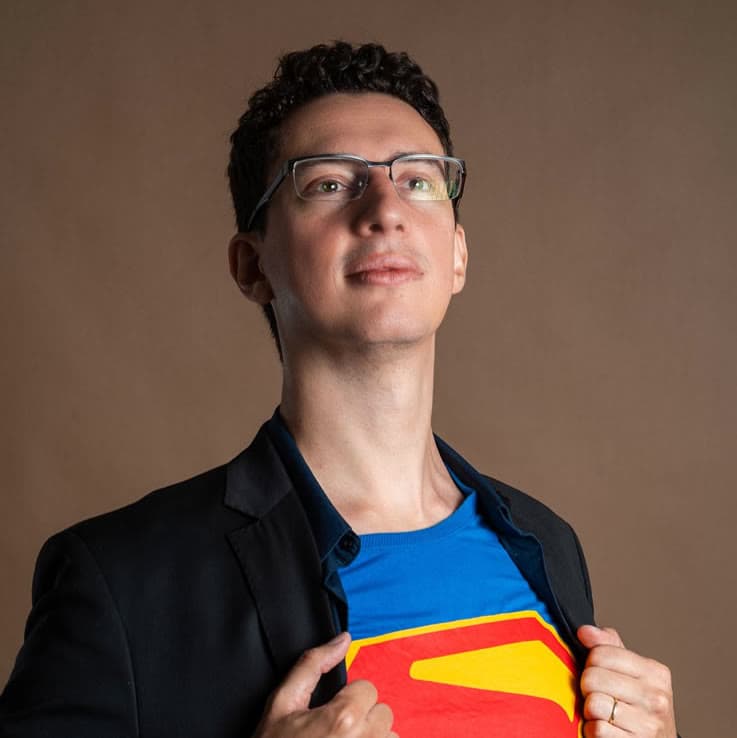
Digo Garcia
Founder and CAIO
Over 20 years in digital. Built and scaled Letras.mus.br, then worked at Méliuz and in the joint venture with Globo.com. Owns AI, technical SEO and engineering inside every project.
Letras.mus.br · Méliuz · Globo.com
André Mousinho
Chief SEO Officer
Comes from Rock Content, Tray/Locaweb and LWSA. Designs the keyword mapping, the content architecture and the GEO strategy that turns a brand into the answer.
Rock Content · Tray/Locaweb · LWSA

Gabriel Raposo
Chief Authority Officer
Leads link building and digital PR at Netlinks and ran, for Netlinks, the authority programs for BTG Pactual and Agibank. Before that, a career at Ambev. Owns the authority that holds up both rankings and citations inside AI answers.
Link building and PR · BTG Pactual and Agibank for Netlinks
And the team behind them: Nathália Barcala (cofounder and COO, governance), Roberto Murta (CTO), Marcelo Ligere (senior advisor, 30+ years, formerly Grupo Globo) and Alfred, the artificial intelligence that runs the day to day: delivery queue, reporting and 24/7 support on WhatsApp.
12Who it is for
Where this work pays off the most
Brands already investing in SEO
They rank well on Google and have no idea whether they appear in AI answers. One run settles it.
Considered purchase markets
High ticket, long decision cycles, where the buyer asks a model before ever contacting a vendor.
Multi-language operations
Answers change by country. We measure in Portuguese, English and Spanish, with the brands of each destination market.
13Case studies
Results with a name, a number and a date
Real projects, with what was done and what changed. No generic charts and no promises of a position.



FAQ
Frequently asked questions
What is AI monitoring?
It is the repeated measurement of your brand's presence in answers from models such as ChatGPT, Gemini, Claude and Perplexity. A question set is executed on a schedule, brand mentions are extracted from each answer, and the results become mention rate, share of voice and competitor comparison.
How do you measure citations in ChatGPT, Gemini, Claude and Perplexity?
Through direct API queries, with the question written in the language and market context of the client. Each execution stores the full answer text, the engine and the date. Mentions are extracted from that answer, which is what makes periods comparable with the same yardstick.
AI answers change every time. How is that a reliable number?
That variability is exactly why measurement runs in repeated rounds, with the same question set and the same engines. A single execution says nothing; the series across months shows the trend, and the trend is what drives decisions.
How is AI monitoring different from an SEO report?
An SEO report measures position, clicks and impressions in a list of results. AI monitoring measures whether your brand is named inside a generated answer. Both readings sit in the same App dashboard, because the same authority and the same content feed both.
How often do the runs happen?
The frequency is set in the contract and the dashboard shows the next scheduled update. Beyond the calendar, the agency triggers extra runs when a moment demands an immediate read: a launch, a reputation issue or a major site change.
Can you track competitors?
Yes, and it is part of the service. You name the companies you compete with, and they are tracked across every answer along with any brands that appear spontaneously. That is how share of voice is measured properly.
Does knowing that I do not appear actually help?
Only when it comes with a plan. Every lost question is classified by cause: missing citable content, missing authority, unclear entity or a technical barrier. Each cause becomes a task in the App queue, and the next run shows whether the fix worked.
Do I need to buy SEO alongside it?
Monitoring can be bought on its own, and that makes sense for teams that just want visibility into the landscape. Changing the outcome, however, requires work on content, authority and technical health, which is what SEO consulting and GEO cover in the same plan.
Do you monitor in English and Spanish?
Yes. Netlinks works in Portuguese, English and Spanish, with headquarters in Belo Horizonte and structure in London, Santiago and Panama City. Questions are written in the language of the market, because both the answer and the brands cited change by country.
Keep reading
Related services
Next step
Get a diagnosis of your case
Tell us what your company sells and to whom. One of the three looks at your scenario, points out what is holding organic back today and shows where we would start.
- A review of your site and your market, with no commitment
- An answer from a senior specialist within 24 business hours
- A direct conversation: what can be done, in what order and how deep
Prefer WhatsApp?
Chat directly with a Netlinks Expert on WhatsApp.
Rather talk now? WhatsApp is answered by the team, with Alfred covering the rest of the day.
Talk to an Expert
Fill out the form and we will get back to you within 24 business hours.